
Tag Archive for: Rural Access Hospital

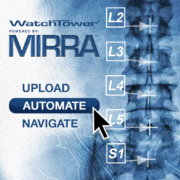
WatchTower spine navigation system powered by MIRRA
Captiva Spine – WatchTower Spine Navigation System powered by MIRRA.

WatchTower®, Powered by MIRRA™, a next-generation system enhancement, is designed to automate 2D-to-3D registration using pre-op CT and C-arm images.  The system eliminates the need for expensive intra-operative CT imaging equipment and reduces dependence on and costs of operator support, improving affordability and broadening adoption.

__________

Key Takeaways

  • WatchTower Spine Navigation, powered by MIRRA, automates 2D-to-3D registration using existing pre-op CT and C-arm images.
  • The system eliminates the need for costly intra-operative CT equipment, improving affordability and adoption.
  • MIRRA enhances simplicity and efficiency, providing automatic alignment and mapping for surgeons.
  • WatchTower is designed for broader market adoption and is accessible to various healthcare facilities without heavy investment.
  • Captiva Spine focuses on delivering innovative spinal care solutions that enhance quality while managing healthcare costs.

__________

JUPITER, FL – April 2026 — Captiva Spine®, Inc., today announced an initial U.S. case series with Aaron Creek, M.D., of The Neck and Back Institute of Florida, centered on the evaluation of the WatchTower ROAM Spine Navigation System Powered by MIRRA™.

MIRRA offers Smart Registration for the WatchTower Spine Navigation System

The WatchTower Spine Navigation System is a 2D-to-3D navigation platform that uses a pre-op CT and standard AP and lateral C-arm images to enable real-time 3D spine navigation.  WatchTower’s proprietary registration algorithm eliminates dependence on expensive intra-operative CT scanning equipment, enabling 3D navigation with equipment the facility already has – the C-arm. 

MIRRA — Map, Identify, Register, Report, and Align — is the next generation of enhanced registration software for the WatchTower Spine Navigation System. At the click of a button, MIRRA is designed to automatically run a proprietary algorithm to accurately align, identify, map, and register a CT scan. MIRRA then provides the surgeon with a concise report for inspection before initiating 3D spine navigation. 

Intuitive design improves simplicity and efficiency for spine navigation

“Registration is the workflow step that makes 3D spine navigation of any kind possible.  It is the most consequential step,” said Dale Mitchell, President of Captiva Spine. “Our objective with MIRRA is to make the WatchTower® Spine Navigation System automatic and intuitive, which translates to efficient ease of use.”

“MIRRA is a breakthrough solution,” said Dr. Creek. “I’ve completed over 250 cases with the WatchTower Spine Navigation System and have firsthand experience with other spine navigation systems. WatchTower has become my go-to platform. WatchTower, powered by MIRRA, is simple and intuitive, adding a new level of reliability and efficiency I know my peers will appreciate.”

System design enables broader market adoption without compromise

WatchTower, powered by MIRRA, aligns with Captiva’s broader product plans and the market’s growing demand for enabling technology that can be extended to additional service sites without imposing major infrastructure or financial burdens.  WatchTower improves access to enabling technology by reducing initial investment and long-term operating expenses, thereby lowering the total cost of ownership.

“As important as the clinical utility is”, said Mitchell, “the broader impact of WatchTower Spine Navigation System is its applicability to a wider range of service sites.  WatchTower is well-suited for traditional major metropolitan medical centers and smaller community hospitals. With MIRRA automation and no dependence on intra-operative CT scanning, it is also well positioned for outpatient centers (ASC), critical access hospitals (CAH), and rural access hospitals (RAH) seeking to avoid major CT scanner purchases and reduce long-term operating costs.”

“Medical costs are a national debate, and surgeons are increasingly involved in managing the business of medicine,” said Dr. Creek, “I operate at a variety of institutions. While MIRRA is impressive, I am equally impressed by how effectively my navigation distributor can support cases across multiple facilities during the week, with the same unit. This underscores the value of the system’s transportability for real-world use. Technologies like WatchTower Spine Navigation play a significant role in delivering quality care across all service sites. WatchTower provides me the performance I need for my patients while also managing costs.”

Advancing Commercial Readiness for WatchTower Spine Navigation System Powered by MIRRA

Captiva will initiate these advanced updates for WatchTower System customers in mid-2026 and accelerate commercial placements to meet demand. Contact Captiva Spine at info@captivaspine.com.

About Captiva Spine, Inc.

Captiva Spine, founded in 2007, is a privately held medical device company that brings healthcare providers, distribution professionals, and surgical facilities together with innovative spinal care solutions. With a focus on quality, Captiva Spine strives to develop reliable systems that offer clinical and economic solutions to the spine market.

Captiva Spine – Navigating Today.

__________

__________

This Press Release is also featured on PrWeb.com;

Frequently Asked Questions (FAQ)

What is MIRRA?

MIRRA stands for Map, Identify, Register, Report, and Align. It is a next-generation software enhancement for the WatchTower Spine Navigation System designed to automate and simplify the registration workflow.

Why is registration important in spine navigation?

Registration is the step that connects the patient’s imaging to the navigation workflow. As noted in the article, it is the most consequential step because it makes 3D spine navigation possible.

How does the WatchTower Spine Navigation System work?

The WatchTower system is a 2D-to-3D spine navigation platform that uses a pre-operative CT scan along with standard AP and lateral C-arm images to enable real-time 3D spine navigation.

What makes WatchTower different from systems that rely on intraoperative CT?

WatchTower is designed to eliminate dependence on expensive intra-operative CT scanning equipment by using imaging tools many facilities already have, particularly the C-arm. This can reduce infrastructure burden and lower the total cost of ownership.

Why is WatchTower ROAM well-suited for multiple service sites?

The system is positioned for broader adoption because it avoids reliance on intra-operative CT, reduces cost barriers, and supports use across a wider range of facilities, including major medical centers, community hospitals, ambulatory surgery centers (ASC), critical access hospitals (CAH), and rural access hospitals (RAH).

When will these MIRRA-powered updates become available?

Captiva Spine stated that it plans to initiate these advanced updates for WatchTower system customers in mid-2026 and accelerate commercial placements to meet demand.
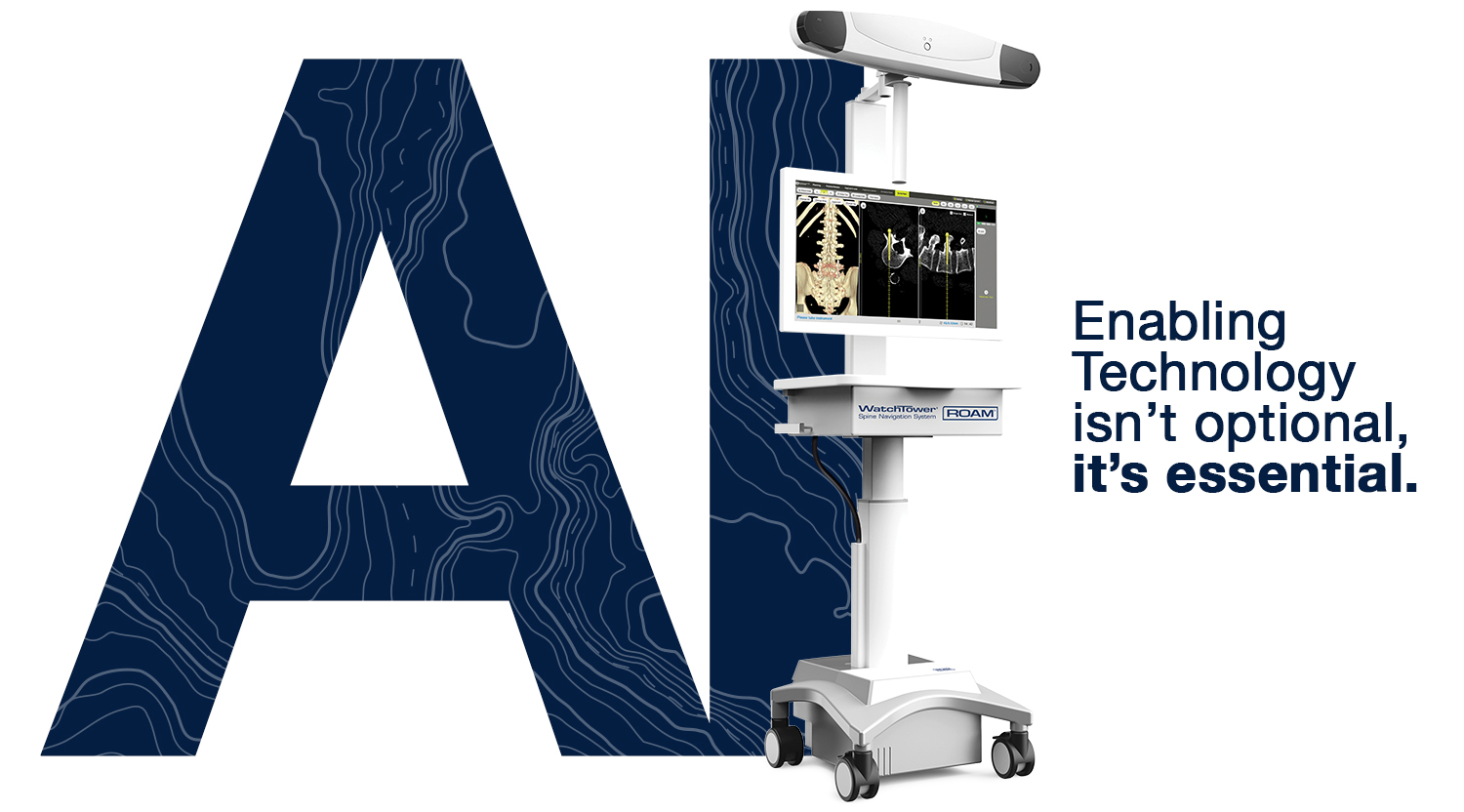
Captiva Spine WatchTower Spine Navigation System AI Enabling Technology
AI – Enabling Technology isn’t optional, it’s essential.

Today’s facilities demand enabling technologies that integrate seamlessly into existing workflows without driving up costs or requiring new infrastructure. The WatchTower Spine Navigation System was designed around this philosophy: simple setup, familiar imaging, and precise guidance without workflow disruption.

JUPITER, FL – November 2025 — In an era when technology is rapidly reshaping spine surgery and contributing to the standard of care in spine, navigation platforms still struggle to strike a balance between precision and practicality, especially in outpatient settings where cost, space, and radiation exposure are most critical. Captiva Spine® is addressing this challenge head-on with a series of advancements to its WatchTower® Spine Navigation System, aiming to make spine navigation more straightforward and accessible in the next generation of surgical environments.

Captiva Spine announced U.S. Food and Drug Administration (FDA) 510(k) clearance for new 21 cm and 31 cm Flat-Panel C-Arm Image Calibrators and AI-assisted 2D-to-3D image registration. For its WatchTower Spine Navigation System, these are advancements that further define the essential role of enabling technology.

The Challenge: Balancing Precision, Practicality, and Cost

For years, spine navigation has wrestled with trade-offs between precision and practicality. High-cost, CT-based systems deliver accuracy but introduce complexity, time, and radiation exposure, factors that can slow adoption and limit accessibility.

Today’s facilities demand enabling technologies that integrate seamlessly into existing workflows without driving up costs or requiring new infrastructure. The WatchTower Spine Navigation System was designed around this philosophy: simple setup, familiar imaging, and precise guidance without workflow disruption.

The Solution: Real-Time 3D Navigation Using the C-Arm Your Facility Owns

WatchTower transforms standard C-arm fluoroscopy into a real-time 3D navigation environment, eliminating the need for intraoperative CT. With the newly cleared flat-panel calibrators, the system now supports the latest square-detector C-arms that deliver sharper, lower-dose images.

This release extends compatibility while maintaining support for 9” and 12” round C-Arm image intensifiers, ensuring continuity for all users. By combining real-time navigation with lower radiation and broader hardware compatibility, WatchTower continues to build on both safety and scalability.

“These clearances go beyond simple compatibility; they reaffirm Captiva’s commitment to keeping facilities ahead of the curve,” said Dale Mitchell, President of Captiva Spine. “As imaging evolves, WatchTower evolves with it, whether using round or flat-panel detectors, surgeons can expect consistent precision and an even safer environment for their teams and patients.”

AI-Assisted Registration: Intelligent Alignment

The newly cleared AI-assisted image registration is more than a feature; it is a foundation for Captiva Spine’s next-generation software environment (UI/UX). This AI alignment engine automates key steps while maintaining surgeon control and verification, reducing operator dependency and improving consistency.

This next phase of WatchTower software is targeted to debut commercially in 2026, alongside a redesigned user interface and workflow enhancements focused on faster setup and intuitive intraoperative guidance.

“Our development path has always been surgeon-led,” said Erik Gottschalk, Director of Sales. “Each update responds to what surgeons need in real practice: fewer steps, faster registration, and adaptable imaging options. The use of AI capabilities dramatically improves scalability, allowing less dependency on the technical operator, and is even more user-friendly at the point of use.”

A Surgeon’s Perspective: Precision Without Complexity

Simon Chao, MD, Orthopedic Spine Surgeon at University Orthopedics

“WatchTower has become an essential part of my workflow,” said Simon Chao, MD, Orthopedic Spine Surgeon at University Orthopedics serving the greater Boston, MA area. “It’s reliable, precise, and fully compatible with the imaging systems we already use. The addition of flat-panel integration further reduces radiation without altering how we operate, enabling WatchTower utilization at more facilities using this newer version of C-Arm fluoroscopy.”

This alignment between surgeon experience and system design underscores a broader trend: enabling technology succeeds when it simplifies, rather than replacing, existing processes and workflows. The market favors systems that are intuitive, open, and scalable, those that can be adopted without disrupting established routines.

Beyond Spine Navigation: A Complete Spine Solutions Portfolio

Captiva Spine’s commitment to enabling technology extends beyond navigation. The company offers a comprehensive portfolio of spinal solutions, including cervical fixation and interbody cages, lumbar fixation, expandable cages, and sacroiliac joint fusion systems.

This full continuum of care allows Captiva to deliver integrated solutions, from planning and navigation to final fixation, making the company a single-source partner for hospitals and ASCs seeking both clinical and economic value.

“We provide a complete ecosystem of spinal solutions supported by enabling technology that improves efficiency, safety, and access. Navigation enhances every implant we make, and every implant reinforces the value of navigation,” added Mitchell.

Mobility, Openness, and Economic Efficiency

The WatchTower ROAM Spine Navigation System configuration offers full-function navigation in a compact, mobile footprint, making it ideal for hospitals and ASCs. With rapid setup and open-platform compatibility across implant systems, ROAM supports procedural flexibility from cervical and lumbar fusion to SI joint fixation, all without dependence on proprietary robotics or specialized infrastructure.

In a climate where capital budgets are under pressure, WatchTower provides a pragmatic path forward, offering advanced navigation that fits within existing environments, staffing, and equipment.

Captiva Spine will showcase the WatchTower ROAM Spine Navigation System at the North American Spine Society (NASS) 2025 Annual Meeting in Denver, Colorado, November 14-16. Attendees will have the opportunity to experience WatchTower’s unique combination of adaptability, precision, and real-time 3D spine navigation firsthand.

About Captiva Spine, Inc.

Captiva Spine, founded in 2007, is a privately held medical device company that brings healthcare providers, distribution professionals, and surgical facilities together with innovative spinal care solutions. With a focus on quality, Captiva Spine strives to develop reliable systems that offer clinical and economic solutions to the spine market.

Captiva Spine – Navigating Today.

__________

__________

Captiva, a privately held organization, has recently unlocked opportunities for strategic investment and continues to build distribution partnerships, capitalizing on its current momentum to expand market share in 2025 and beyond. For investment or distribution inquiries, contact us at info@captivaspine.com.

__________

This Press Release is also featured on PrWeb.com; TheSpineMarketGroup.com;

Dr. Aaron Creek with the Captiva Spine WatchTower Spine Navigation Platform for ASCs and Rural Access Hospitals
Aaron Creek, MD of The Neck and Back Institute of Florida, Miramar Beach, FL

The WatchTower Spine Navigation System is designed to be uncomplicated, compact, and cost-effective. The Navigation Platform empowers surgeons with CT-based accuracy and streamlined workflows, eliminating the need for intraoperative CT scans.

Jupiter, FL – April 2025 – Captiva Spine®, a privately held medical device company specializing in spinal implants and enabling surgical technologies, announced today that it doubled year-over-year revenue month-to-date (MTD) in Q1 2025. This substantial growth is directly attributed to the accelerated market adoption of the company’s WatchTower Spine Navigation System and the newly launched ROAM unit, which boasts a compact footprint, WatchTower’s 2D to 3D registration capabilities, and an updated navigation platform.

This performance highlights the company’s continued commitment to delivering cost-effective, scalable navigation technology to underserved market segments, including Ambulatory Surgery Centers (ASCs) and Rural Access Hospitals (RAHs), two key verticals in the evolving U.S. spine care landscape.

“The WatchTower System offers a best-in-class navigation platform that’s efficient and accurate. Its compact design and ability to work with any implant make it a game-changer for all types of spinal cases,” said Aaron Creek, MD of The Neck and Back Institute of Florida, Miramar Beach, FL. Additionally, the WatchTower System is a breakthrough for rural communities like ours. Its simplicity and affordability finally bring advanced spinal navigation within reach for our patients.”

Dr. Mark Grubb with the Captiva Spine WatchTower Spine Navigation Platform for ASCs and Rural Access Hospitals
Mark Grubb, MD of the Center for Orthopedic and Spine Institute, Cleveland, OH

“ASC budgets demand careful management, but a commitment to procedural quality must remain unwavering.  WatchTower’s advanced 2D to 3D registration algorithm affords an economical real-time 3D navigation alternative for the ASC by leveraging the imaging equipment we already own, C-arms,” said Mark Grubb, MD of the Center for Orthopedic and Spine Institute, Cleveland, OH.  “Additionally, bringing navigation into the ASC eliminates anatomical ambiguity and has aided us in opening additional service lines like SI fusion.”

Captiva Spine’s WatchTower Spine Navigation System will be featured at the AANS (American Association of Neurological Surgeons) Annual Meeting held in Boston, MA, April 25-27, 2025.

Growth Story: A Scalable Platform, Expanding Market

Captiva’s performance in Q1 reflects strong adoption of multi-site procedures and implant systems. WatchTower’s open navigation architecture allows a consistent experience across the full-featured WatchTower SNS and the compact mobile ROAM platform.  This created new procedural volume and positions Captiva as a long-term partner in spine care transformation.

Key drivers of Q1 growth included:

  • The rapid adoption of WatchTower ROAM in ASC settings, where portability, price, and efficiency are critical.
  • Strategic expansion into RAH facilities, with many adopting spine navigation for the first time.
  • Repeat utilization and add-on implant pull-through support procedural revenue and recurring business.
  • New distribution partnerships and expanded geographic reach across core U.S. spine markets.

“Our universal navigation platform, launched earlier this year, continues to drive adoption by making enabling technology more accessible across high-growth outpatient centers and underserved community hospitals,” said Dale Mitchell, President of Captiva Spine. “This platform has opened the door to new partnerships with independent distributors and spine implant companies, allowing WatchTower Navigation to enhance its clinical offerings. Our strong year-over-year revenue growth reflects the platform’s alignment with clinical needs and economic priorities in today’s spine care market.”

Looking Ahead: Strong Pipeline, Continued Expansion, and AI (Artificial Intelligence)

Following its Q1 performance, Captiva Spine is entering Q2 and Q3 with a robust sales pipeline.  The company will continue to schedule system placements in existing territories and expand its navigation and core implant presence into new high-growth territories. Additionally, WatchTower’s agnostic capabilities have opened the opportunity for strategic industry partnerships. Captiva expects this system capability to provide additional partnership opportunities in the thoracolumbar and SI fusion markets. 

Later this year, the company will also announce additional product enhancements and software updates with AI to increase procedural utility, simplify operator tasks, and integrate across more procedures.

Captiva, a privately held organization, has recently unlocked opportunities for strategic investment and continues to build distribution partnerships, capitalizing on its current momentum to expand market share in 2025 and beyond. For investment or distribution inquiries, contact us at info@captivaspine.com.

About Captiva Spine, Inc.

Captiva Spine, founded in 2007, is a privately held medical device company that brings healthcare providers, distribution professionals, and surgical facilities together with innovative spinal care solutions. With a focus on quality, Captiva Spine strives to develop reliable systems that offer clinical and economic solutions to the spine market.

Captiva Spine – Navigating Today.

__________

__________

This Press Release is also featured on PrWeb.com